
Cloud security is the security of an application, data, infrastructure, and network in cloud computing. Security in public cloud is a shared responsibility between user and cloud service provider. Many organization uses Hybrid cloud to have better security so that they can keep the most sensitive data in private cloud within own data center boundary. Shared responsibility also gets changed with the cloud vendor and what is in SLA that you signed.
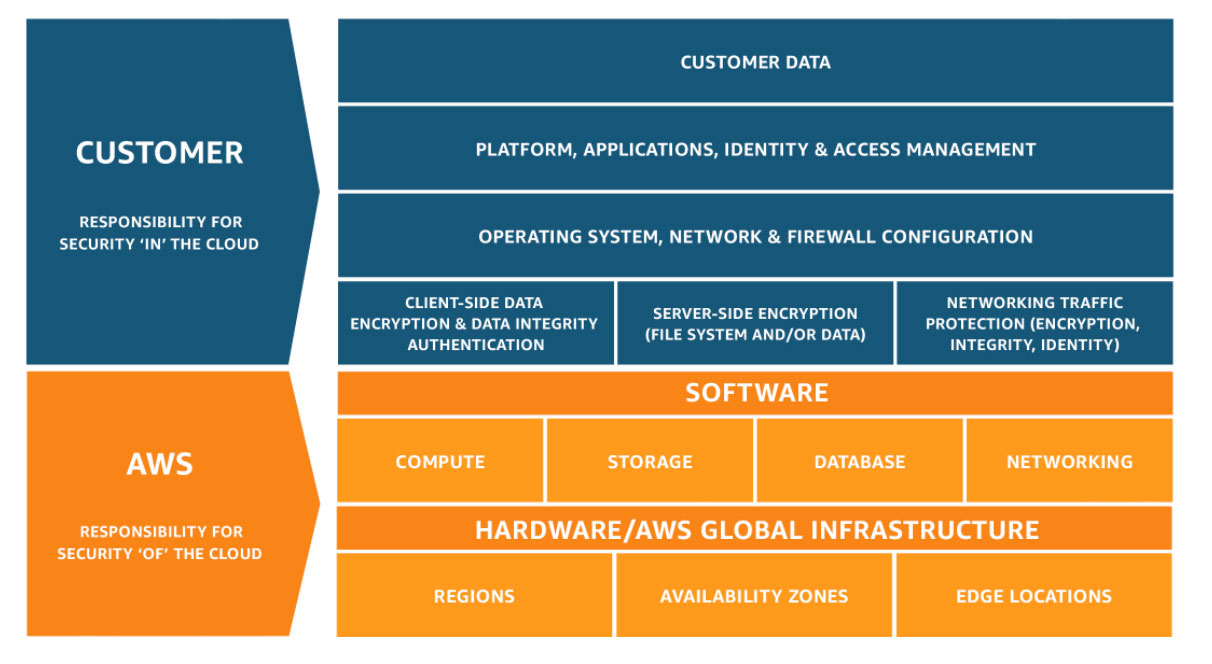
AWS defines shared responsibility as AWS is responsible for “security of the cloud” that means hardware, software, networking, and facilities that run AWS Cloud services. Customer is responsible for “security in the cloud” means If a customer deploys an Amazon EC2 instance, they are responsible for management of the guest operating system (including updates and security patches), any application software or utilities installed by the customer on the instances, and the configuration of the AWS-provided firewall (called a security group) on each instance.
Before designing security first you should do the cost-benefit analysis and risk tolerance of organization. Every workload does not require the highest level of encryption and security.
If you are migrating from your data center to cloud, you will need to have all the security measures that you have an on-premises data center. But when you are migrating from in-house data center to third-party data center, you have to put some additional security measure because of multi-tenancy nature of the public cloud.
To ensure security, cloud vendor and cloud customer can use Cloud Controls Matrix (CCM), a control framework provided by Cloud Security Alliance (CSA), that provides industry-accepted security standards. The CSA CCM is specifically designed to provide fundamental security principles to guide cloud vendors and to assist prospective cloud customers in assessing the overall security risk of a cloud provider. As a framework, the CSA CCM provides organizations with the needed structure, detail, and clarity relating to information security tailored to the cloud industry.
A report published by Cloud Security Alliance (CSA) about the top threats of cloud computing, using security guidelines and this report below is the main point to consider for security:
- Data Breaches: Any data or information that is not intended for unauthorized access is stolen because of human error, application vulnerabilities, or poor security practices. The primary objective of a targeted attack is data breaches.
- Weak Identity, Credential, and Access Management: Lack of identity and access management system and credential policy is the main reason for data breaches. Identity management system must support immediate de-provisioning of access to resources when personnel changes. We can consider multifactor authentication system. TLS certificates, keys used to protect the access of data and keys used to encryption of data at rest must be rotated periodically. There should be a provision to enforce change password periodically.
- Malicious Insiders: CERN defines an insider threat as follows: “A malicious insider threat to an organization is a current or former employee, contractor, or other business partner who has or had authorized access to an organization’s network, system, or data and intentionally exceeded or misused that access in a manner that negatively affected the confidentiality, integrity, or availability of the organization’s information or information systems.”
- Advanced Persistent Threats (APTs) : Spearphishing, direct hacking systems, delivering attack code through USB devices, penetration through partner networks and use of unsecured or third-party networks are common points of entry for APTs. Awareness programs that are regularly reinforced are one of the best defenses against these types of attacks because many of these vulnerabilities require user intervention or action.
- Denial of Service (DoS): Denial-of-service (DoS) attacks are attacks meant to prevent users of a service from being able to access their data or their applications. By forcing the targeted cloud service to consume inordinate amounts of finite system resources such as processor power, memory, disk space or network bandwidth, the attacker—or attackers, as is the case in distributed denial-of-service (DDoS) attacks—causes an intolerable system slowdown and leaves all legitimate service users confused and angry as to why the service is not responding.
- Network Security in the cloud: Ensuring the confidentiality and integrity of an organization’s data-in-transit is very important in network security. Stratoscale identifies the following four principles of network security in cloud computing:
- Isolation between multiple zones should be guaranteed using layers of firewalls.
- Network controls for traffic to and from their applications.
- End-to-end transport level encryption should be used by applications.
- Standard secure encapsulation protocols such as IPSEC, SSH, SSL should be used when deploying a virtual private cloud.
To reduce vulnerability in the cloud, organizations can consider below steps:
- Make sure everyone in the organization understands Cloud Service Provider’s shared responsibility model and its impact based on their role in an organization.
- Good planning is required for selecting an appropriate tool and technology or any applications to move in the cloud. Also, a good amount of analysis and planning needed to buy vs build analysis.
- Ensure all steps should be taken to maintain the availability of your application.
- Should have good real-time and continuous monitoring and alert mechanism in place, so that you can identify prospective threat upfront. For example, you started getting a huge hit from an area where you do not have any customer, or you can catch if anyone trying continuously with a different wrong token to access your system.
- Always rotate cryptographic key and TLS key based on regular or irregular rotation strategy you have chosen.
- Continuously learning about the latest trends and vulnerabilities and keep updating your security plan and tools accordingly.
- Implements best practices for deployments and ensure to have full automation.
- Ensure proper use of Identity and Access Management (IAM) for assign user access rights and resource access policies.


